The Economics of AI Employees
How Agentive®'s AI Employees (AI agents working for us) deliver projects 70% cheaper while maintaining quality through human expert supervision.
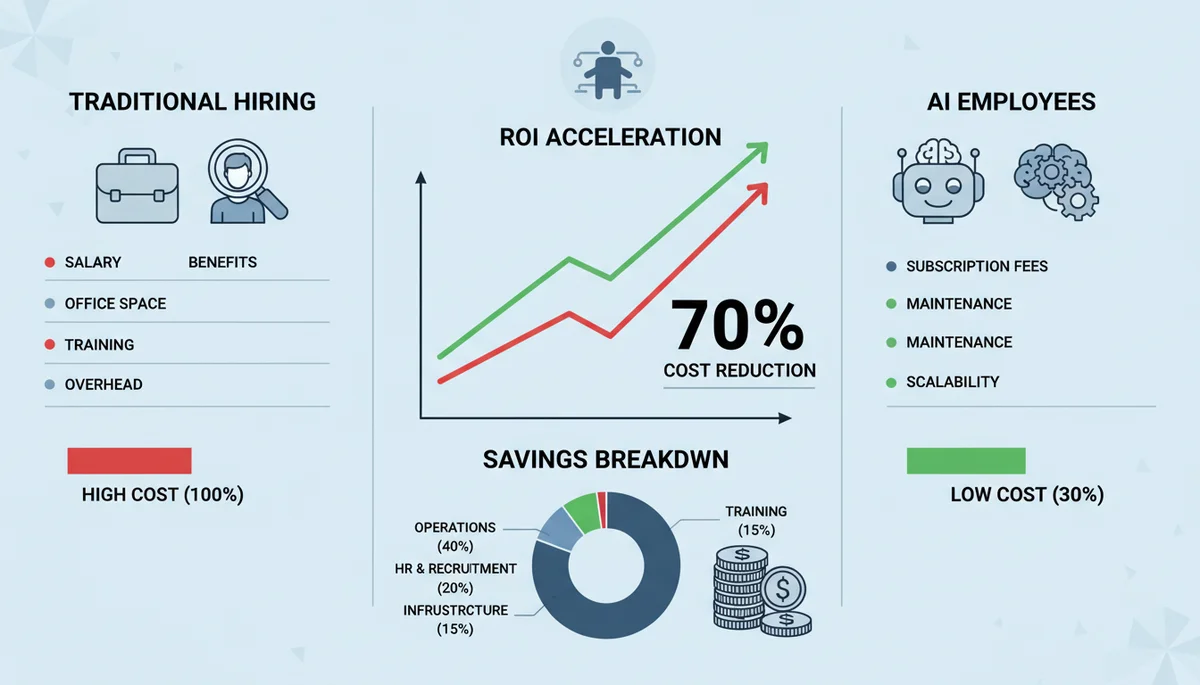
When we claim Agentive®'s AI Employees can reduce project costs by 70%, skepticism is natural. How can our AI-Native Platform deliver better quality at such lower costs? The answer lies in our proprietary Self-Improving Multi AI Agent System working under human expert supervision. This isn't about cutting corners, it's about eliminating inefficiencies baked into traditional consulting models.
The Hidden Costs of Human Consulting
When you hire a consultant at $200/hour, you're not just paying for their expertise. You're paying for an entire ecosystem of overhead:
Anatomy of a $200/Hour Consultant
But that's just the beginning. The real inefficiencies come from how human work actually happens:
The Productivity Reality Check
Where Does an 8-Hour Day Really Go?
Time Breakdown:
- • Meetings & calls: 2.5 hours
- • Email & communication: 1.5 hours
- • Context switching: 1 hour
- • Breaks & interruptions: 1 hour
- • Actual productive work: 2 hours
Efficiency Killers:
- • Rework from miscommunication
- • Waiting for dependencies
- • Knowledge transfer overhead
- • Learning curve on new projects
- • Coordination complexity
Research shows knowledge workers average only 2-3 hours of deep, productive work per day. You're paying $200/hour for someone who's productive 25% of the time.
The AI Employee Advantage
AI employees operate on fundamentally different economics. They eliminate entire categories of cost while delivering superior productivity:
AI Employee Cost Structure
The Productivity Multiplier
But the real magic happens when you factor in productivity differences:
Human Consultant
- • 8 hours billed = 2 hours productive
- • Works 40 hours/week max
- • Sequential task execution
- • Knowledge limited to individual
- • Quality varies with fatigue
AI Employee
- • 8 hours = 8 hours productive
- • Works 168 hours/week
- • Parallel task execution
- • Collective knowledge access
- • Consistent quality 24/7
Apples to Apples: Real Output Cost
When you normalise for actual productive output, the economics become crystal clear:
Cost Per Unit of Actual Work
Human Consultant:
$200/hour × 8 hours = $1,600 for 2 hours of productive work
= $800 per productive hour
AI Employee:
$60/hour × 8 hours = $480 for 8 hours of productive work
= $60 per productive hour
93% Cost Reduction Per Unit of Output
The Economics of Scale
The advantages compound dramatically at scale:
| Project Size | Human Team Cost | AI Team Cost | Savings |
|---|---|---|---|
| Small (1 month) | $160,000 | $48,000 | $112,000 (70%) |
| Medium (3 months) | $640,000 | $144,000 | $496,000 (78%) |
| Large (6 months) | $1,920,000 | $288,000 | $1,632,000 (85%) |
| Enterprise (12 months) | $5,760,000 | $576,000 | $5,184,000 (90%) |
*Assumes 10-person human team vs. equivalent AI capacity. Larger projects show greater savings due to reduced coordination overhead.
The Hidden Savings
Beyond direct labor costs, AI employees eliminate numerous hidden expenses:
Eliminated Costs:
- Recruitment & hiring ($15-50K per hire)
- Onboarding & training (3-6 months)
- Office space & equipment
- Travel & expenses
- Turnover & knowledge loss
- Benefits & insurance
- Sick days & vacation time
Reduced Costs:
- Project management overhead (80%)
- Communication delays (90%)
- Rework from errors (85%)
- Scope creep (75%)
- Quality assurance time (60%)
- Documentation effort (90%)
- Maintenance burden (70%)
ROI: Beyond Cost Savings
The return on investment extends far beyond direct cost savings:
Total Economic Impact
Speed to Market
60% faster delivery = earlier revenue realisation
Opportunity Cost
Complete 3x more projects with same budget
Quality Premium
Fewer defects = lower maintenance costs
Strategic Advantage
Execute initiatives competitors can't afford
Case Study: Real Project Economics
E-commerce Platform Integration
Traditional Approach:
- • Team: 12 consultants
- • Timeline: 4 months
- • Total hours: 7,680
- • Productive hours: ~1,920
- • Cost: $1,536,000
- • Cost per productive hour: $800
AI-Powered Approach:
- • Team: 45 AI agents + 2 humans
- • Timeline: 3 weeks
- • Total hours: 7,560
- • Productive hours: 7,200
- • Cost: $453,600
- • Cost per productive hour: $63
Result: 70% cost reduction, 81% faster delivery, 3.75x more productive hours
The Future of Work Economics
As AI capabilities continue to improve, the economic advantage will only grow:
Improving AI Efficiency
Model costs dropping 90% annually while capabilities increase exponentially
Network Effects
Each project makes AI agents smarter, reducing costs for all future work
Scale Advantages
Infrastructure costs amortize across more projects as adoption grows
The Economic Imperative
The economics of AI employees aren't just compelling, they're transformative. When you can deliver better quality at 70% lower cost, it's not just a competitive advantage; it's a new business model entirely.
The question isn't whether AI will transform the economics of professional services. It's whether you'll be driving that transformation or watching from the sidelines as competitors leverage 10x productivity gains.
March 2026 Update
By early 2026, AI model inference costs have dropped by over 90% compared to mid-2025, making the economics of AI employees even more compelling. Businesses adopting AI-native platforms are now reporting ROI within the first two weeks rather than the first month. With Australian SMBs accelerating AI adoption at record pace, the cost advantage gap between traditional consulting and AI-powered delivery continues to widen.
Related: Explore the AI Employee Cluster
- What Is an AI Employee? — Agentive’s AI Operation Engine pillar: single-tenant, AWS Sydney hosted, designed for APRA, ASIC and TPB aligned Australian finance professionals.
- AI Employee for Bookkeepers — Xero reconciliation, BAS, GST, AR/AP, multi-file health checks.
- AI Employee for Accountants — multi-client management, white-label reports, practice CRM.
- AI Employee for Financial Advisors — SOA drafting, onboarding, ASIC RG 255 aligned (early access).
- What Is an AI Employee? — Australian Business Guide — the definitive category guide.
Ready to Transform Your Economics?
Discover how AI employees can transform your next project.