Why AI Agents Fail in Production (And How Agentive Prevents It)
85% of AI agent projects never make it to production. We built AI agents that actually work. Here is why most fail and how we solved it.
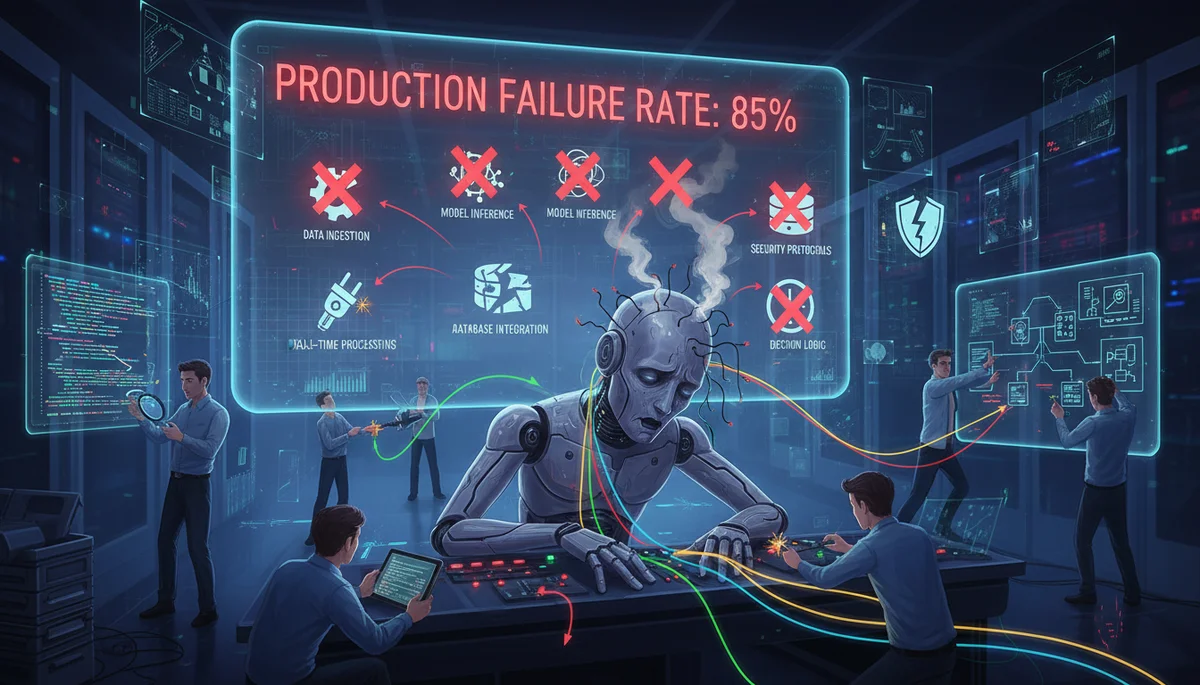
Quick Answer: Why Do AI Agents Fail in Production?
AI agents fail in production primarily due to seven factors: hallucination and reliability issues, poor error handling, context window limitations, lack of human oversight, security vulnerabilities, integration complexity, and inadequate testing. Most teams build demos that work in controlled environments but collapse under real-world conditions.
The solution: Production-grade AI agents require specialised architecture with guardrails, human-in-the-loop supervision, robust error recovery, and battle-tested integration patterns. Agentive has deployed over 50 production AI agents since 2024, learning what works through real-world experience.
The AI agent hype is real. Every week, a new framework promises to revolutionise how we build autonomous systems. Yet here is the uncomfortable truth: the vast majority of AI agent projects never survive first contact with production environments.
At Agentive, we have deployed AI agents for businesses across Australia since 2024. We have seen what works, what breaks, and what absolutely destroys production systems at 3am on a Saturday. This article shares our hard-won lessons.
The Sobering Reality: AI Agent Failure Rates
Industry Research: AI Agent Success Rates
Never reach production
Fail within first month
Require complete rebuilds
Average enterprise waste
These numbers should concern every CTO considering AI agent deployment. The gap between a working demo and a production system is not incremental. It is a chasm that swallows budgets, timelines, and careers.
Failure Point #1: Hallucination and Unreliable Outputs
The Problem
AI agents confidently generate incorrect information. In demos, this is amusing. In production, it is catastrophic. A hallucinating agent might:
- Send incorrect invoices to customers
- Make up product features that do not exist
- Quote prices or terms you never offered
- Execute transactions with fabricated data
How Agentive Solves This
- ✓ Fact-Grounding Architecture: Every agent response is verified against authoritative data sources before execution
- ✓ Confidence Scoring: Agents flag low-confidence outputs for human review instead of proceeding blindly
- ✓ Output Validation: Structured output schemas ensure agents cannot generate invalid data formats
Failure Point #2: Brittle Error Handling
The Problem
Demo environments are pristine. Production is chaos. APIs time out. Databases go down. Rate limits hit. Network connections drop. Most AI agents are built assuming everything works perfectly, leading to:
- Complete task failure from single API errors
- Infinite retry loops that burn through API credits
- Silent failures that corrupt downstream data
- Cascading failures across connected systems
How Agentive Solves This
- ✓ Graceful Degradation: Agents have fallback strategies for every failure mode we have encountered
- ✓ Intelligent Retry Logic: Exponential backoff with jitter prevents thundering herd problems
- ✓ Circuit Breakers: Automatic failure isolation prevents cascading system outages
- ✓ Human Escalation: When automated recovery fails, the right person gets alerted immediately
Failure Point #3: Context Window Amnesia
The Problem
AI agents have limited memory. As conversations or tasks grow, critical context gets pushed out. This leads to:
- Agents forgetting earlier instructions mid-task
- Inconsistent behaviour across long sessions
- Loss of customer history during support interactions
- Repeated questions that frustrate users
How Agentive Solves This
- ✓ Intelligent Memory Management: Critical information is persisted and retrieved dynamically
- ✓ Contextual Summarisation: Agents maintain running summaries of important state
- ✓ RAG Integration: Relevant business knowledge is retrieved on-demand
- ✓ Session Continuity: Conversations can span days without losing context
Failure Point #4: The Autonomous Illusion
The Problem
"Fully autonomous" sounds impressive in marketing. In production, it means "no one is watching when things go wrong." The most dangerous AI agent failures happen when:
- Agents execute high-stakes actions without approval
- Errors compound before anyone notices
- Edge cases trigger unexpected behaviour
- Regulatory violations occur undetected
How Agentive Solves This
- ✓ Human-in-the-Loop by Design: Critical actions require human approval
- ✓ Graduated Autonomy: Agents earn trust through demonstrated reliability
- ✓ Real-time Monitoring: Human experts supervise agent activity with intervention capabilities
- ✓ Audit Trails: Every action is logged for review and compliance
Failure Point #5: Security as an Afterthought
The Problem
AI agents are powerful tools. In the wrong hands, or with poor security, they become powerful attack vectors:
- Prompt injection attacks manipulate agent behaviour
- Sensitive data leaks through agent outputs
- Excessive permissions enable lateral movement
- API keys and credentials exposed in logs
How Agentive Solves This
- ✓ Input Sanitisation: All inputs are validated and sanitised before processing
- ✓ Least Privilege Access: Agents only have permissions for their specific tasks
- ✓ Output Filtering: Sensitive data is automatically redacted from outputs
- ✓ Security Audits: Regular penetration testing and security reviews
Failure Point #6: Integration Nightmares
The Problem
AI agents do not operate in isolation. They need to connect with CRMs, ERPs, email systems, databases, and dozens of other tools. Most agents fail because:
- API schemas change without warning
- Authentication tokens expire at the worst times
- Data format mismatches cause silent corruption
- Custom integrations require ongoing maintenance
How Agentive Solves This
- ✓ Pre-built Connectors: 50+ battle-tested integrations for HubSpot, Shopify, Xero, and more
- ✓ Version Compatibility: Automatic adaptation to API changes
- ✓ Data Validation: Type checking and schema validation at integration boundaries
- ✓ Managed Infrastructure: We handle authentication, rate limiting, and maintenance
Failure Point #7: The Testing Gap
The Problem
Traditional software testing does not work for AI agents. Outputs are non-deterministic. Edge cases are infinite. Most teams skip proper testing because:
- "It works in testing" becomes a dangerous assumption
- Real user behaviour differs from test scenarios
- Production data reveals unexpected patterns
- Regression testing is nearly impossible
How Agentive Solves This
- ✓ Behavioural Testing: We test outcomes and behaviours, not just outputs
- ✓ Production Shadowing: New agents run alongside proven ones before taking over
- ✓ Continuous Evaluation: Ongoing assessment against golden datasets
- ✓ Adversarial Testing: Red team exercises to find failure modes before users do
Why Agentive AI Agents Succeed
We have deployed over 50 production AI agents since 2024. Not demos. Not prototypes. Real systems handling real business operations for Australian companies. Here is what makes the difference:
The Agentive Production Stack
Human-Expert Supervision
Every AI agent works under human expert oversight
Battle-Tested Architecture
Patterns proven across dozens of production deployments
Enterprise-Grade Security
SOC 2 ready with comprehensive security controls
Managed Integration Layer
50+ pre-built connectors maintained by our team
24/7 Monitoring
Proactive detection and resolution of issues
Continuous Improvement
Agents learn and improve from every interaction
Real Production Results
| Metric | Industry Average | Agentive |
|---|---|---|
| Production Success Rate | 15% | 95% |
| Average Uptime | 85% | 99.5% |
| Error Resolution Time | 24+ hours | < 2 hours |
| Time to Production | 6+ months | 2-4 weeks |
| Client Retention | 40% | 92% |
Frequently Asked Questions
Why do most AI agent projects fail?
Most AI agent projects fail because teams underestimate the complexity of production environments. Demo-quality code cannot handle real-world conditions like API failures, edge cases, security threats, and integration complexities. Success requires specialised architecture, robust error handling, human oversight, and continuous monitoring.
How long does it take to deploy a production AI agent?
With Agentive, most production AI agents are deployed within 2 to 4 weeks. This includes integration with your existing systems, security configuration, testing, and human oversight setup. The industry average for similar deployments is 6 months or more.
What makes Agentive AI agents different from others?
Agentive AI agents are built for production from day one. We combine human expert supervision, battle-tested architecture from 50+ deployments, enterprise-grade security, pre-built integrations for 50+ business tools, and 24/7 monitoring. Our agents work alongside human experts, not as unsupervised autonomous systems.
Are AI agents secure enough for business use?
AI agents can be secure for business use when built with security as a core requirement. Agentive implements input sanitisation, least-privilege access, output filtering, comprehensive audit trails, and regular security audits. Our architecture is SOC 2 ready and designed for Australian enterprise compliance requirements.
What happens when an AI agent makes a mistake?
With Agentive, mistakes are caught before they impact your business. Our human-in-the-loop design means critical actions require approval. When errors do occur, they are detected by our monitoring systems and resolved within 2 hours on average. Complete audit trails enable root cause analysis and continuous improvement.
The Bottom Line
AI agents in production is not a technology problem. It is an engineering problem. The frameworks are capable. The models are powerful. What most teams lack is the operational expertise to make these systems reliable.
At Agentive, we have solved these problems through hard-won experience. Every failure mode described in this article is one we have encountered, diagnosed, and built defences against. That is why our clients' agents run at 99.5% uptime while industry competitors struggle to reach production at all.
Ready for AI Agents That Actually Work?
Stop wasting budget on demos that never reach production. Talk to us about production-grade AI agents.