The Use Cases, Risks, and Realities of Super General AI Agents
They promise to replace entire toolchains. Critics warn they are a concentrated point of failure. Here is a balanced, rigorous look at where general AI agents genuinely add value, where the risks remain unresolved, and what organisations should consider before adopting them.
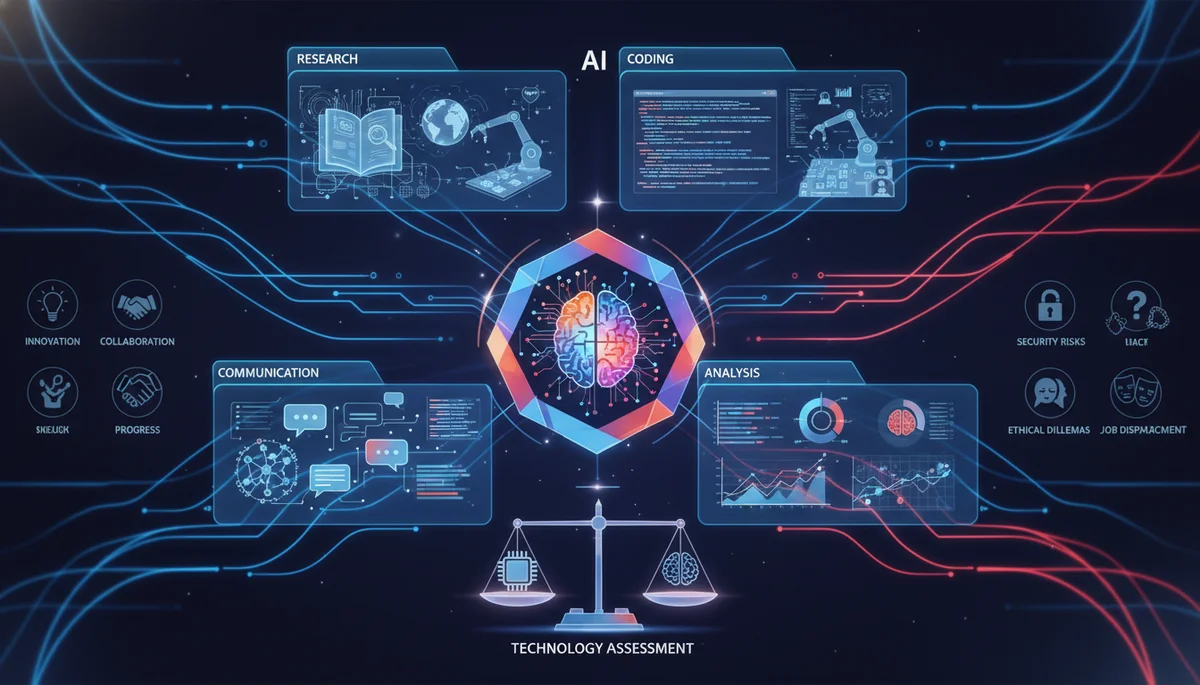
A new class of AI tool is emerging that refuses to be pigeonholed. Unlike single-purpose chatbots or narrow workflow automations, "super general" AI agents aim to do it all: manage your books, operate your CRM, draft your emails, deploy your infrastructure, and analyse your data, all from a single conversational interface. Services like Agentive's AI Employee represent one example of this category, combining orchestration across business tools such as Xero, HubSpot, and cloud platforms into a unified agent layer.
The promise is tantalising: one intelligent system that connects the dots across every domain your business touches. But the ambition also invites hard questions about reliability, security, accountability, and whether "good enough at everything" can truly outperform "excellent at one thing."
This article synthesises the strongest arguments from both sides of that debate, drawing on a structured 10-round exchange between AI advocates and sceptics. The goal is not to declare a winner, but to map the terrain that businesses, regulators, and technologists must navigate as these tools mature.
Orchestration vs Specialisation: The Central Tension
The most fundamental question about general AI agents is whether breadth is a strength or a liability. Critics invoke the "jack of all trades, master of none" principle. A system attempting to handle accounting, CRM management, deployment, and arbitrary coding tasks simultaneously, the argument goes, will inevitably lack the depth that purpose-built tools provide. When the margin for error in financial operations or customer data management is razor thin, that lack of depth matters.
Advocates counter with a crucial distinction: well-designed general agents do not reinvent accounting or CRM software. They orchestrate existing specialist tools through their own APIs. Xero still handles the compliance logic. HubSpot still manages the pipeline data model. The agent provides the intelligent layer that connects these platforms, enabling cross-domain workflows that no single-purpose tool could achieve alone. This is integration, not replacement.
Key Insight: The Orchestration Model
The strongest argument for general agents is not that they do everything well in isolation. It is that they connect specialist platforms intelligently. A customer email that requires checking payment status in Xero, updating a deal in HubSpot, and sending a follow-up; that workflow spans three tools. Rigid automation platforms like Zapier can handle predefined versions of this flow, but they cannot reason about novel variations. A general agent can.
However, this model depends on the quality of API integrations and the agent's ability to correctly interpret which tool to invoke and with what parameters. When that interpretation fails, the consequences compound across every connected system.
The sceptical response is worth taking seriously: if the value is merely orchestration, why not use deterministic integration platforms that offer predictable workflows, proper error handling, and established security certifications? The AI layer adds a degree of unpredictability that may not be proportional to its benefit for routine integrations. The answer, advocates argue, lies in the reasoning capability. When a customer emails with an unusual request that spans multiple systems, Zapier does nothing because no workflow was pre-built for that scenario. A general agent understands the context, determines the appropriate actions, and proceeds intelligently. That reasoning layer is not unpredictability; it is the core innovation.
Democratising Access to Expertise
Perhaps the most emotionally compelling case for general AI agents is accessibility. Consider the sole trader in regional Australia who currently cannot afford a bookkeeper, a developer, and an IT consultant. They stuff receipts in shoeboxes and scramble at tax time. A general agent that helps them categorise expenses correctly throughout the year, even imperfectly, delivers vastly better outcomes than the status quo.
This is not a hypothetical scenario. Australia has a well-documented shortage of accountants and bookkeepers, and regional and rural businesses face particular difficulty accessing professional services. The advocate's argument is straightforward: general AI agents do not need to be perfect; they need to be better than the realistic alternative, which for many small businesses is nothing at all.
The sceptical counterpoint cuts deep: accessibility without reliability is not empowerment; it is risk redistribution onto those least equipped to manage it. When a tradie's AI agent miscategorises personal expenses as business deductions, the ATO does not care that the system was "better than a shoebox." Incorrect records are arguably worse than no records, because they create false confidence. At least the shoebox tradie knows they need professional help at tax time.
Both Sides of the Accessibility Coin
The Promise
- • Flattens capability gaps between large firms and sole traders
- • Fills genuine service gaps in regional areas
- • Reduces cost barriers to professional-grade operations
- • Provides auditable records where none existed before
The Risk
- • Users may lack expertise to verify agent outputs
- • Errors in regulated domains carry real consequences
- • False confidence can be worse than acknowledged ignorance
- • Professional shortage means fewer humans to catch mistakes
The analogy to spreadsheets is instructive here. Spreadsheets did not replace accountants entirely, but they empowered millions of small business owners to handle routine financial tasks themselves, consulting professionals only when genuinely needed. General AI agents may follow a similar adoption pattern. The critical difference, however, is that spreadsheets are deterministic; the same formula produces the same result every time. AI agents are stochastic. The same prompt can produce different outcomes on different days. That distinction matters enormously when handling financial data or infrastructure decisions.
Security: Centralisation as Both Shield and Target
An agent with access to AWS credentials, accounting tokens, API keys, and CRM systems represents a concentrated attack surface. One compromised session or prompt injection could theoretically expose an entire business's operational infrastructure. This is the digital equivalent of handing the keys to every room in the house to a single entity.
Advocates respond by noting that the argument cuts both ways. Managing ten separate logins, credentials, and permission sets across fragmented tools actually increases attack surface through human error: reused passwords, forgotten deactivations, and unpatched integrations. A centralised agent can enforce structured permission modes, require explicit user approval for sensitive operations, and log every tool call for audit. This can be more transparent than a human clicking through interfaces with no record.
The strongest sceptical concern relates to prompt injection, a novel attack vector with no equivalent in traditional software. Scoped permissions sound reassuring until you consider that prompt injection operates at the reasoning layer itself. It does not matter that a finance skill "cannot touch AWS" if a crafted input manipulates the agent's reasoning about which skill to invoke. Defences against this class of attack remain immature, and comparing an early-stage AI agent's security to decades of hardened banking infrastructure flatters enormously.
The Compartmentalisation Debate
Security orthodoxy favours compartmentalisation: if one system is compromised, the blast radius is contained. General agents, by design, bridge compartments. Advocates argue that modern agent architectures implement scoped permissions, where individual skills have defined access boundaries and cannot cross into other domains. Sceptics counter that this compartmentalisation is enforced by the same reasoning layer that prompt injection targets, making it fundamentally less reliable than traditional access controls.
The truth likely sits in the middle. Layered defences, including input sanitisation, tool-use sandboxing, and user confirmation for high-stakes actions, can meaningfully reduce risk. But claiming that these measures are equivalent to mature, heavily regulated security frameworks is premature. Honest communication about the current maturity level is essential for building trust.
The Oversight Paradox: Who Watches the Agent?
One of the most intellectually interesting tensions in this debate is what might be called the "oversight paradox." Advocates consistently point to human-in-the-loop confirmation as a safety mechanism: the agent asks clarifying questions, presents options, and requires approval for consequential actions. The human remains in the loop and bears responsibility, just as they do when using any professional tool.
But sceptics identify a structural contradiction. If users must vigilantly monitor every operation, the productivity gains evaporate. You cannot simultaneously claim the agent saves enormous time and claim that user oversight provides adequate safety. The value proposition requires users to trust outputs they may lack the expertise to verify.
The advocate's rebuttal draws an analogy to management: a manager does not monitor an employee's every action to maintain accountability. They review outputs, spot-check work, and investigate anomalies. Smart systems can batch low-risk actions and escalate only consequential decisions, similar to how mobile banking uses tiered authentication where small transfers proceed silently while large ones require biometric confirmation.
The sceptic's response is sharp: managers reviewing employee work possess domain expertise to identify errors. The small business owners using general agents, by the advocate's own admission, lack precisely this expertise. Asking someone who cannot do bookkeeping to spot-check AI bookkeeping is not oversight; it is the illusion of oversight. Furthermore, confirmation fatigue is well documented. When an agent requests approval dozens of times daily, users rubber-stamp approvals without genuine review. The guardrail becomes theatre.
The Oversight Spectrum
Rather than treating oversight as binary (full surveillance or blind trust), practical adoption likely requires a graduated approach:
Accountability: Who Bears the Consequences?
When a human employee makes an error, there is a clear chain of responsibility. When an AI agent silently executes a flawed deployment, sends an incorrect invoice, or mishandles sensitive customer data, the liability question becomes murky. The vendor typically disclaims responsibility through terms of service. The AI cannot be held accountable in any meaningful sense. The user, who was sold on the promise of not needing deep expertise, bears all consequences.
This accountability vacuum is arguably the most urgent unsolved problem in the general agent space. Advocates correctly note that every tool, from spreadsheets to ERP systems, creates potential for user error, and the responsibility has always ultimately rested with the business. But sceptics push further: there is a meaningful difference between a tool that executes exactly what you tell it (deterministic) and a tool that interprets your intent and acts on its inference (stochastic). The latter introduces a category of error that is qualitatively different from anything business owners have previously managed.
The auditability argument also deserves scrutiny. Advocates tout logged reasoning as a transparency advantage: every categorisation decision an agent makes is recorded with its justification. But sceptics rightly observe that logged reasoning from a large language model is post-hoc rationalisation, not genuine causal explanation. The model generates plausible justifications for its outputs, but these "explanations" do not reliably reflect the actual computational process that produced the decision. Auditing fabricated reasoning may provide false assurance rather than genuine transparency.
Regulation: Evolution vs Precaution
The debate about regulatory timing reveals a deep philosophical divide. Advocates argue that regulation has always evolved alongside technology, not before it. The Privacy Act, consumer protection laws, and financial services regulations all developed in response to technologies that were already in widespread use. Waiting for comprehensive regulatory frameworks before deployment sounds reasonable but ignores how regulation actually develops.
Sceptics counter with historical examples where that evolutionary approach proved catastrophic: asbestos, thalidomide, and subprime mortgages all operated in regulatory gaps while frameworks "evolved." The cost of that evolution was borne disproportionately by ordinary users, not by the technology vendors who profited. Proactive regulation is not paralysis; it is learning from preventable disasters.
The pragmatic middle ground recognises that some form of deployment is necessary for regulation to be informed and effective, but that deployment should be accompanied by honest capability claims, meaningful safeguards, and clear liability structures. The worst outcome would be widespread adoption based on inflated promises, followed by a regulatory backlash that constrains even responsible applications.
What Responsible Adoption Looks Like
Start small and validate
Begin with low-stakes tasks, validate outputs against known benchmarks, and gradually expand scope as confidence builds
Demand transparency
Vendors should be honest about current capabilities and limitations rather than borrowing credibility from mature industries
Maintain human expertise
Use AI agents to augment, not replace, professional judgment in regulated domains; periodic expert review remains essential
Push for industry standards
Support the development of independent auditing standards and meaningful liability structures for AI agent providers
Deskilling, Scope Creep, and Institutional Knowledge
As businesses lean on general agents for tasks once handled by skilled staff, a subtler risk emerges: the erosion of institutional knowledge. When the agent fails or the provider changes terms, the organisation may find it has hollowed out its own capability. This is not unique to AI; outsourcing of any kind carries similar risks. But the speed and comprehensiveness of AI-driven delegation amplifies the danger.
Closely related is the problem of scope creep. Advocates propose that skill-based architectures enforce boundaries structurally: you cannot accidentally hand the agent payroll if no payroll skill is configured. This architectural restraint is genuinely valuable. But sceptics observe that scope creep is a behavioural pattern, not just a technical one. Once a business owner sees the agent handling expense categorisation successfully, the temptation to extend it to payroll, tax lodgement, and client communications becomes difficult to resist. The incremental framework exists in theory; in practice, convenience consistently overrides caution.
The honest assessment is that organisations adopting general AI agents should deliberately maintain parallel human competency in critical functions, at least during the current maturity phase. This adds cost, but it provides a safety net that becomes invaluable when the technology encounters its inevitable edge cases.
Determinism vs Stochasticism: A Fundamental Challenge
Beneath many of the specific concerns about general AI agents lies a more fundamental issue. We are deploying stochastic systems in domains that traditionally demand deterministic behaviour. Financial records, infrastructure configuration, and regulatory compliance all require predictable, verifiable outcomes. Large language models, by their nature, do not guarantee this.
Advocates argue this overstates the practical impact. Modern AI agents do not randomly guess expense categories. They apply consistent reasoning based on transaction descriptions, merchant data, and established patterns. When genuinely ambiguous, well-designed agents flag the transaction for human review rather than guessing. This is demonstrably more reliable, the argument goes, than a tired sole trader manually categorising hundreds of transactions at midnight before a BAS deadline.
The sceptic's sharpest insight on this point is about calibration. The most dangerous errors are not the ones the system knows it is uncertain about. They are the confident mistakes: transactions categorised decisively but incorrectly. LLM calibration research consistently shows overconfidence in edge cases. A system that is "more reliable than a tired sole trader" but less reliable than a competent professional creates a new category of risk: systematically plausible but subtly wrong records at scale.
Where General Agents Genuinely Excel
After weighing the arguments rigorously, certain use cases emerge as genuinely strong for general AI agents, even accounting for the valid criticisms.
Strong Use Cases
- • Cross-system workflows where reasoning about novel combinations is required
- • Draft generation for documents, emails, and reports where human review is the natural next step
- • Research and analysis where breadth of context is more important than precision
- • Developer productivity for code reviews, test generation, and documentation
- • Operational visibility through consolidated summaries and anomaly detection
Proceed with Caution
- • Tax and regulatory compliance where errors carry legal consequences
- • Financial transactions involving payments, transfers, or binding commitments
- • Infrastructure changes in production environments without rollback capabilities
- • Client-facing communications where misrepresentation carries professional liability
- • Any domain where the user cannot verify the output independently
The common thread is that general agents are strongest when they support human judgment rather than substitute for it, and when the cost of occasional errors is low enough that the productivity gains clearly outweigh the risk.
The Maturity Question: Early Adopter Reality
Every transformative technology from online banking to cloud computing faced identical objections during its early phases, and matured through real-world deployment rather than theoretical perfection. This is a valid and historically well-supported observation. But sceptics add important nuance: what happened during those maturation periods was not costless. Early online banking saw billions in fraud losses, class-action lawsuits, and regulatory interventions that took years to resolve. Saying "it worked out eventually" ignores the real harm borne by early adopters.
The technology will improve. Prompt injection defences will mature. Regulatory frameworks will emerge. Calibration and reliability will increase. The question for businesses today is not whether general AI agents will be useful, but whether the current generation is mature enough for their specific use case, and whether they are prepared for the growing pains.
A measured approach to adoption, starting with non-critical tasks, maintaining human fallback capabilities, and choosing vendors who are transparent about limitations rather than those who overpromise, is the most rational path forward.
Conclusion: Nuance in an Age of Hype
The debate over super general AI agents reveals that both evangelists and sceptics hold essential pieces of the truth. Generality is genuinely powerful when it means intelligent orchestration across domains, not shallow imitation of specialist tools. The accessibility gains for underserved businesses are real and meaningful. The reasoning capability that distinguishes agents from rigid automation is a genuine innovation, not marketing spin.
Equally, the concerns about security, accountability, oversight, and the deployment of stochastic systems in deterministic domains are not fear-mongering. They are structural challenges that thoughtful architecture can mitigate but not eliminate. The oversight paradox, where user review is both the primary safety mechanism and an unrealistic expectation, remains genuinely unresolved.
The most productive stance is neither uncritical adoption nor reflexive rejection. It is informed engagement: understanding what these tools can and cannot do today, deploying them where the risk-reward balance is favourable, maintaining human competency in critical functions, and holding vendors to honest capability claims. The businesses that navigate this balance well will gain meaningful competitive advantages. Those that adopt blindly, or refuse to adopt at all, will both pay a price.
Key Takeaways
Orchestration is the real value proposition
General agents excel not by replacing specialist tools, but by connecting them intelligently across domains. The reasoning capability that enables novel cross-system workflows is the genuine differentiator from rigid automation.
The oversight paradox demands honest design
Tiered review models, where low-risk actions proceed autonomously and high-stakes decisions require explicit confirmation, offer a practical path. But vendors must be transparent that no AI system is fully self-supervising in consequential domains.
Accessibility gains are real but come with responsibility
For millions of small businesses, the realistic alternative to AI assistance is not professional expertise; it is no support at all. Imperfect help with guardrails can be better than no help, but only if limitations are clearly communicated.
Security and accountability remain unsolved
Prompt injection, concentrated attack surfaces, and the liability vacuum are structural challenges, not marketing objections. The industry needs independent auditing standards and clear liability frameworks before general agents can be trusted in high-stakes environments.
Exploring AI Agents for Your Business?
The right approach starts with understanding your specific needs and risk tolerance. Whether you are evaluating general AI agents or purpose-built solutions, an informed conversation is the best first step.