The Future of AI Employee Businesses: Promise, Peril, and the Path Forward
AI employees are no longer speculative. They are here, they are scaling, and they are forcing a reckoning with questions we have barely begun to answer. This analysis examines both sides of the debate.
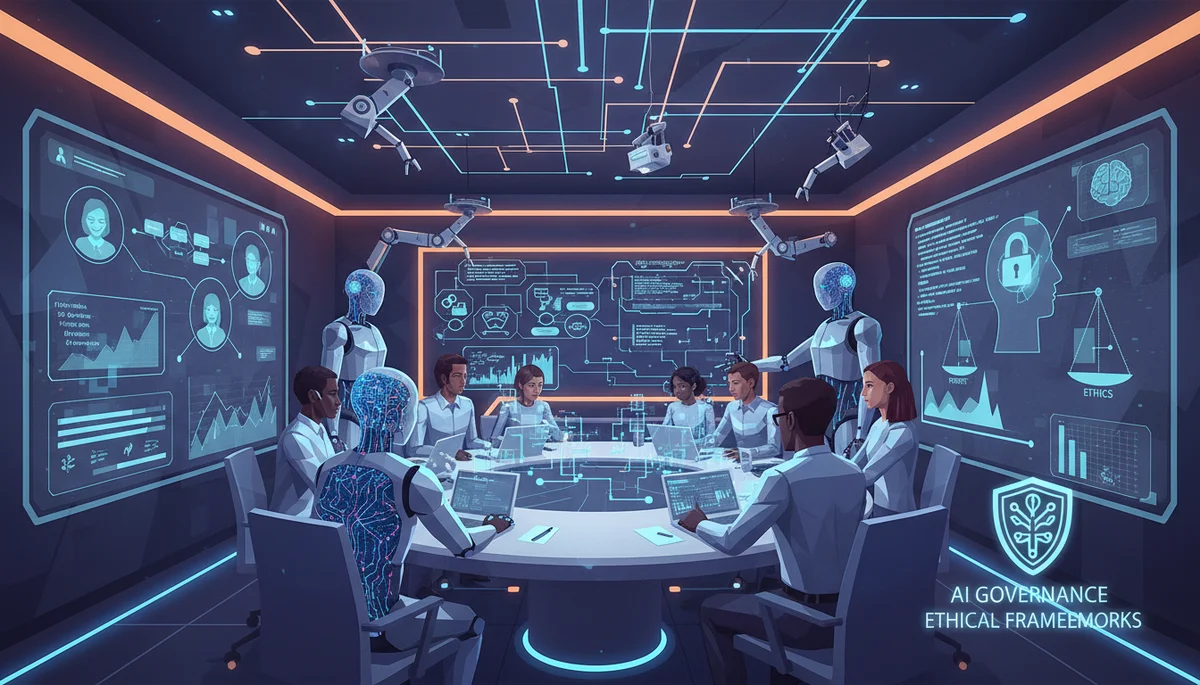
Something fundamental is shifting in how businesses operate. Across industries, from accounting firms in Melbourne to marketing agencies in London, organisations are deploying AI agents that function as digital team members: handling research, managing customer relationships, processing invoices, drafting reports, and executing tasks that once required a human sitting at a desk. These are not chatbots answering FAQ pages. They are increasingly autonomous systems integrated into business workflows, operating around the clock, and improving continuously.
The AI Employee business model has moved from concept to commercial reality with remarkable speed. But as adoption accelerates, so does the urgency of the questions surrounding it. Is this a democratising force that levels the playing field for small businesses? Or is it the beginning of a structural economic disruption that will hollow out the knowledge workforce before protective frameworks can catch up?
The honest answer is that it is probably both. And the outcome will depend less on the technology itself than on the choices businesses, policymakers, and communities make in the next few years. This article examines the most consequential arguments on each side, drawing on a rigorous debate between proponents and critics of the AI Employee model.
The Transformative Promise: Why AI Employees Are Gaining Traction
The economics driving AI Employee adoption are difficult to argue with. A traditional business faces a painful trade-off: grow headcount and accept rising costs, or stay lean and accept capacity constraints. AI employees dissolve this tension. A five-person consultancy can deploy AI agents to handle research, reporting, scheduling, and client follow-ups, effectively operating with the throughput of a team several times its size.
For Australian small and medium enterprises competing against larger firms with deeper pockets, this levels the playing field dramatically. AI employees do not require salaries, superannuation, leave entitlements, or office space. They work around the clock without burnout. In competitive markets, this cost structure creates breathing room to invest in innovation, better customer experiences, and human talent development.
Proponents argue that the savings do not eliminate jobs; they fund growth that creates new, higher-value roles. The vision is a hybrid workforce where AI handles execution, analysis, and routine operations while humans focus on strategy, creativity, and relationships. Companies like Agentive, an Australian provider of managed AI Employee services, illustrate how this model is already being packaged for SMEs that lack the technical capacity to build such systems themselves. It is a service layer that abstracts away the complexity, much as Gmail abstracted away the need to run your own email server.
The Demand Expansion Argument
Perhaps the strongest case for AI employees rests on a fundamental economic principle: when costs drop dramatically, markets do not simply shrink to fewer workers doing the same volume. They explode in scale. Cheap computing did not eliminate programmers; it created millions of them by making software viable for problems previously too expensive to solve.
If AI employees follow this pattern, reduced costs will enable business expansion, unlocking activities that currently do not exist because they are not economically feasible. The result would be more work, not less, just different work.
Market signals support the optimistic reading. Global spending on AI automation is accelerating. Enterprise adoption is moving from experimentation to production deployment. And the technology itself is becoming increasingly specialised: imagine an organisation where one AI handles accounts receivable through Xero, another manages the sales pipeline in HubSpot, and a third monitors infrastructure, all coordinated by a human manager whose role shifts from doing to directing.
The Structural Risks: What the Optimists Underestimate
The optimistic narrative, however, rests on assumptions that deserve rigorous scrutiny. Critics raise several challenges that cannot be dismissed as mere pessimism.
Labour Displacement at Scale
When businesses can subscribe to an AI employee for a fraction of a human salary, the economic incentive to replace workers is overwhelming. Unlike previous automation waves that displaced manual labour while creating knowledge work, AI employees target knowledge work itself. There is no obvious "next tier" of employment waiting to absorb displaced workers. The historical precedent of technology creating more jobs than it destroys may simply not hold this time.
The arithmetic is stark. One AI orchestration manager overseeing twenty AI agents replaces nineteen human workers. Proponents point to new roles in prompt engineering, agent orchestration, and workflow design, but these roles require a fraction of the workforce they displace. And critically, the speed differential matters enormously. Previous transitions took generations to absorb displaced workers; AI deployment operates on a timeline of months.
The "Fragments" Problem
One of the most compelling critiques concerns what happens when you strip routine tasks from professional roles. Most jobs are bundles of tasks. A bookkeeper does not just do "bookkeeping" in the abstract; they manage client relationships, interpret ambiguous transactions, communicate with suppliers, and exercise judgement in grey areas. The bookkeeping portion, the core routine work, is precisely what AI automates. But removing the automatable components often destroys the role entirely rather than elevating it.
The elegant career pivot narrative, where the bookkeeper becomes a "business advisor" or "financial strategist", assumes a seamless upward transition that research from the Productivity Commission suggests rarely materialises in practice. Displaced workers overwhelmingly move to lower-paying roles, not higher-value ones. The graceful transitions happen for a privileged minority with existing networks, education, and financial resilience. For the majority, displacement means downward mobility.
The Henry Ford Problem
Even if individual businesses benefit from AI employees, what happens to aggregate demand when millions of knowledge workers lose purchasing power? Consumer spending drives roughly 60% of GDP. An economy that systematically replaces consumers with software is undermining the very market it depends on.
Henry Ford understood that workers must also be customers. The AI Employee model has no equivalent insight. When a business replaces five workers with AI agents and saves $400,000 annually, that money flows to shareholders and owners, not to creating new positions. Four decades of data on the productivity-wage decoupling show exactly this pattern: productivity gains have overwhelmingly benefited capital, not labour. There is no mechanism forcing reinvestment into human employment.
The ATM Analogy: Lessons and Limitations
Supporters of AI employees frequently cite the ATM example as evidence that automation creates more jobs than it destroys. When ATMs automated bank teller transactions, the number of bank tellers initially increased because cheaper branch operations meant more branches. The freed-up human capacity was redirected toward relationship banking, financial advice, and sales.
It is an instructive example, but it cuts both ways. Bank teller numbers increased temporarily in the 1990s due to deregulation enabling branch expansion, not because ATMs created demand for tellers per se. Since 2000, teller numbers have declined sharply and continuously. Citing a transient anomaly and presenting it as a durable trend obscures the full trajectory.
The broader lesson is more nuanced. Total employment in banking did grow substantially throughout the automation era. The jobs shifted, not vanished. Relationship managers, mortgage brokers, financial planners, and compliance officers emerged as ATMs and online banking handled transactions. But the transition was neither smooth nor equitable, and it played out over decades rather than months.
The question for AI employees is whether the current pace of deployment allows for similar adaptation. The evidence so far suggests the tempo is dramatically faster, which compresses the time available for workers, institutions, and policy frameworks to adjust.
Platform Dependency and the Concentration of Power
A less discussed but critically important risk is platform dependency. If a handful of AI providers become the de facto engine behind millions of businesses' operations, those providers hold extraordinary leverage. A pricing change, a terms of service update, or even an outage could cripple entire sectors simultaneously.
Supporters counter that the market is diversifying rapidly, with multiple foundation model providers competing on price and capability. They point to open-source alternatives like Llama, Mistral, and DeepSeek as evidence that competitive performance is achievable outside Silicon Valley giants. And they note that most AI Employee use cases do not require frontier capabilities; smaller, efficient models handle the majority of business tasks.
Critics respond that this appearance of competition masks an oligopoly in formation. Training frontier models requires billions in compute infrastructure. Only a handful of organisations can compete at the cutting edge, and open-source alternatives consistently lag behind by capability generations. Meanwhile, the foundation model market is consolidating, not diversifying.
For small businesses in particular, the accessibility of open-source models remains theoretical. Most lack the technical capacity to self-host models. Accessibility in principle is not accessibility in practice, which is precisely why managed AI Employee services fill a genuine market need. But that service layer itself introduces another dependency, trading infrastructure complexity for vendor reliance.
The Commoditisation Paradox
An intriguing tension emerges from the debate. If smaller models handle most AI Employee tasks, then AI Employee businesses may have no durable competitive advantage. Any competitor can replicate their offering using the same open models. This creates a potential race to the bottom on pricing that could make the entire business model unsustainable long-term.
However, the same logic applies to many infrastructure businesses. Electricity was commoditised; that did not make it worthless. It became essential infrastructure. AI Employee services will likely compete on integration quality, domain specialisation, reliability, and customer experience, exactly as cloud providers do today. Commoditisation drives adoption, which drives market expansion.
The question is whether this market expansion will be broad enough, and fast enough, to offset the displacement effects. Optimists believe it will. Sceptics point to the productivity-wage decoupling as evidence that productivity gains routinely benefit capital without trickling down. Both have history on their side; the outcomes depend on policy choices, not technological determinism.
The Regulatory Vacuum: Deploying First, Governing Later
Perhaps the most urgent issue is the temporal mismatch between deployment and protection. AI employees are being deployed at production scale today. Protective frameworks remain theoretical. Every month of this gap produces real consequences for displaced workers who cannot wait for policy to catch up.
Key Regulatory Gaps
Unresolved Questions:
- • Who is liable when an AI employee breaches data privacy laws?
- • What happens when an AI agent operating across jurisdictions violates local regulations?
- • How should displaced workers be supported during the transition?
- • What transparency obligations exist when customers interact with AI?
Proposed Policy Instruments:
- • Mandatory transition funds levied on companies deploying AI employees
- • Portable retraining entitlements for displaced workers
- • Sectoral bargaining rights that include AI deployment decisions
- • Human employment ratios in essential services
Notably, these are not utopian proposals. Variations of each instrument already operate across Scandinavia, where countries like Denmark and Germany automated heavily while maintaining strong wage growth through deliberate policy choices. The tools exist. What is lacking is political urgency and implementation.
Supporters of AI employees argue that these protections should complement adoption, not delay it. Denmark succeeded because it built frameworks during technological transitions, not by halting them. Both development and deployment of protections can happen simultaneously.
Sceptics retort that "simultaneously" is doing a great deal of work in that sentence. The protections are years behind the deployment, and asking displaced workers to bear the risk while frameworks are developed amounts to socialising the costs while privatising the profits.
The Retraining Treadmill and the Eroding Capability Boundary
A particularly uncomfortable dimension of this debate concerns the durability of newly created roles. TAFE courses in agent training and workflow design are already being developed. But there is a legitimate question about whether these roles are themselves temporary.
Today's prompt engineer may be tomorrow's automated function. Workers could find themselves on a retraining treadmill, perpetually chasing a receding horizon of relevance. Supporters frame continuous professional development as normal career growth, comparing it to doctors learning new surgical techniques. But there is a categorical difference between a doctor deepening existing expertise and a bookkeeper being told their entire profession is obsolete and they should become a "workflow designer." The former is enrichment; the latter is occupational extinction.
The boundary between human and AI competence is not static. It is eroding quarterly. Proponents argue that humans excel at nuanced judgement, stakeholder navigation, and contextual decision-making. Critics observe that LLM capabilities are advancing rapidly into exactly these domains. Planning workforce strategy around capabilities AI currently lacks is planning for a present that is already passing.
Collaborative Governance: Can Industry and Workers Co-Design the Transition?
One of the more interesting outcomes of this debate is the degree of convergence between opposing sides on what good governance should look like. Both proponents and critics agree on the need for transition funds, retraining entitlements, and sectoral bargaining rights. The disagreement is over sequencing: should deployment proceed alongside these frameworks or wait until they are established?
Advocates for AI employees argue that responsible providers have a vested interest in supporting thoughtful policy development because their long-term viability depends on public confidence. They envision collaborative governance where industry, workers, and government co-design the transition together.
The counterargument is structural. Collaborative governance requires equal bargaining power, which displaced workers by definition do not possess. Asking technology vendors to co-design worker protections raises concerns about the fox designing the henhouse. And competitive pressure adds a coercive dimension: businesses are effectively told to adopt AI employees or perish, which limits the space for genuine deliberation.
Where Both Sides Converge
Transition support is necessary
Workers displaced by AI employees need funded pathways to new roles, not just theoretical possibilities.
Speed is the critical variable
The pace of AI deployment is outstripping society's capacity to adapt. Both sides acknowledge this temporal mismatch.
Policy intervention is required
Market forces alone will not self-correct the structural inequities this transition could produce.
The transition will be uneven
Some workers, industries, and regions will benefit enormously; others will bear disproportionate costs.
Learning from the Agricultural Transition
Those supporting AI Employee adoption often cite the agricultural transition as evidence that massive workforce disruption ultimately leads to greater prosperity. When agricultural automation displaced 90% of farm workers over a century, consumer demand did not collapse. It transformed. Workers moved into manufacturing, services, and knowledge work, creating vastly larger economic output.
But the sceptics' rebuttal is sobering. That "painful but ultimately prosperous" century included the Great Depression, mass migration, child labour in factories, and generational poverty. The unprecedented prosperity that eventually arrived came for the grandchildren of those who suffered through the displacement. That is not an acceptable timeline for policy planning.
The agricultural analogy also falters on a structural point. When farming was automated, there was a clear "next tier" of employment: manufacturing and services. When knowledge work is automated, the path upward is far less obvious. "Strategy, creativity, and relationships" sounds generous until you recognise that it describes perhaps 10% of most knowledge roles. The other 90% is precisely the execution work being automated.
The Quality Ceiling and Strategic Sterility
There is a quieter risk that deserves attention beyond the headline concerns about jobs and wages. AI employees excel at pattern-matching and process execution, but genuine innovation, ethical judgement, and creative problem-solving remain distinctly human capabilities, at least for now. Organisations that replace too aggressively risk becoming operationally efficient yet strategically sterile: able to execute but unable to adapt.
The most thoughtful operators in this space recognise this risk. The hybrid team model, where AI handles execution while humans handle direction, is the most commonly proposed solution. But even this model requires careful implementation. A thin layer of human managers overseeing a large fleet of AI agents is a fundamentally different organisational structure from a traditional team, and we do not yet have established management practices for it.
Conclusion: Neither Utopia nor Dystopia, but a Choice
The future of AI Employee businesses is neither the seamless revolution its most enthusiastic supporters promise nor the catastrophe its harshest critics fear. It is something more complex and more contingent: an outcome that will be shaped by the decisions made in the next few years by businesses, policymakers, workers, and communities.
The technology is real and improving rapidly. The cost advantages are genuine. The demand from SMEs for affordable, capable digital workers is not manufactured; it reflects a legitimate need. But the displacement risks are also real, the regulatory frameworks are absent, and the historical analogies that comfort the optimists are more ambiguous than they acknowledge.
What is needed is not optimism or pessimism, but a commitment to three principles. First, that protective frameworks must be developed concurrently with deployment, not after the damage is done. Second, that the costs of this transition must be borne by those who profit from it, not exclusively by those displaced by it. Third, that democratic oversight should govern the pace and conditions of adoption.
The AI Employee future is not something that happens to us. It is something we are collectively shaping, whether through deliberate action or through neglect. The organisations, providers, and policymakers who understand this will be the ones who build a transition that is both economically productive and genuinely humane.
Key Takeaways
AI Employees Are Already Here
This is not a speculative future. Businesses are deploying AI employees at production scale today, and the economics are compelling enough to drive rapid adoption across sectors.
Displacement Is Real and Fast
Unlike previous automation waves, AI employees target knowledge work directly, and the pace of deployment compresses the time available for adaptation from generations to months.
Historical Analogies Have Limits
The ATM example and the agricultural transition offer lessons, but neither maps cleanly onto the current moment. The speed, scale, and target of AI automation are structurally different.
Governance Must Keep Pace
The temporal mismatch between deployment and protection is the central challenge. Transition funds, retraining entitlements, and sectoral bargaining rights need to move from proposals to implementation.
The Outcome Is a Choice, Not a Fate
Technology does not determine social outcomes. Policy does. The AI Employee future will be shaped by the governance frameworks we build around it, and that work must begin now.
Continue the Conversation
The debate about AI employees is only beginning. Whether you are exploring this technology for your business or thinking about its broader implications, informed perspectives matter.