Which Workflows Can AI Fully Own vs. Just Assist With?
The 2026 shift: teams no longer ask "how can AI help?" but "what can AI run end-to-end?" Understanding which workflows fit each category is now a competitive advantage.
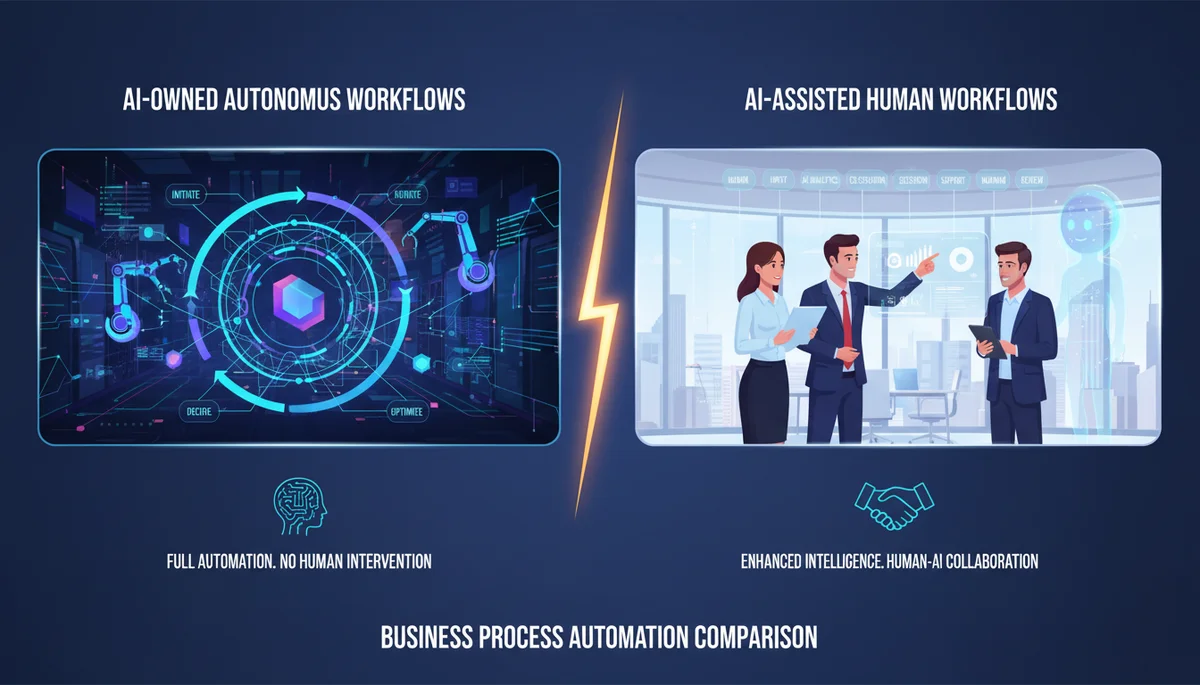
The question has changed. In 2024, business owners asked: "How can AI help my team?" In 2026, the question is: "What can AI run completely without us?"
This is not a subtle shift. It is the difference between AI as a tool and AI as a team member. And understanding which workflows fit each category is now a competitive advantage.
The New Framework: Own vs. Assist
Not all tasks are created equal. Some are perfect for full AI ownership. Others require human judgment at critical points. Getting this wrong means either leaving efficiency gains on the table (not letting AI own what it could) or creating disasters (letting AI own what it should not).
Workflows AI Can Fully Own in 2026
These tasks share common traits: they are repetitive, rule-based, low-stakes if errors occur, and have clear success criteria.
1. First-Line Customer Communication
What AI owns: Answering FAQs via chat, email, or social media; appointment scheduling; order status updates; basic troubleshooting guides.
Why it works: The queries are predictable. Responses follow patterns. Customers increasingly prefer instant responses over waiting for humans.
2. Social Media Content Operations
What AI owns: Drafting posts from content briefs; scheduling across platforms; responding to standard comments; generating image assets; republishing evergreen content.
Why it works: Social media is relentless. Consistency matters more than perfection. AI can maintain presence while you focus on strategy.
3. Data Entry and Migration
What AI owns: Extracting data from documents; entering data into CRMs and spreadsheets; cleaning and deduplicating records; migrating data between systems.
Why it works: Humans hate this work. They make errors when bored. AI does not get bored and maintains consistent accuracy.
4. Report Generation and Distribution
What AI owns: Pulling data from multiple sources; creating formatted reports; generating visualisations; distributing to stakeholders on schedule; highlighting anomalies for review.
Why it works: Report creation is mechanical. The intelligence is in interpreting results, which is where humans add value.
5. Meeting Administration
What AI owns: Scheduling across time zones; sending calendar invites and reminders; transcribing meetings; generating summaries and action items; following up on action item completion.
Why it works: These tasks are time-consuming but straightforward. AI handling them frees significant hours weekly.
6. Invoice and Expense Processing
What AI owns: Receiving and categorising invoices; matching to purchase orders; flagging discrepancies for review; processing approved payments; generating expense reports.
Why it works: Accounts payable follows strict rules. AI can process faster and catch errors humans miss.
Ready to Automate Your Social Media Workflow?
Book a consultation and we will map exactly what your AI can own, freeing you to focus on strategy.
Book ConsultationWorkflows Where AI Should Assist, Not Own
These tasks require judgment, creativity, relationship nuance, or carry significant consequences if done wrong.
1. Strategic Decision Making
AI assists by: Gathering and summarising relevant data; modelling scenarios and projections; identifying patterns in historical decisions; presenting options with pros and cons.
Humans own because: Strategy requires understanding context AI cannot fully grasp. Company culture, market intuition, and stakeholder relationships matter.
2. Complex Sales and Negotiations
AI assists by: Researching prospects before calls; drafting initial proposals; tracking conversation history; suggesting next steps based on patterns.
Humans own because: High-value sales require reading rooms, building trust, and making judgment calls. AI lacks the emotional intelligence for this.
3. Creative Direction and Brand Voice
AI assists by: Generating initial drafts and variations; maintaining consistency with style guides; producing high-volume assets.
Humans own because: Brand differentiation comes from human creativity. AI produces competent work; humans produce remarkable work.
4. Employee Performance and Feedback
AI assists by: Tracking objective metrics; scheduling reviews; suggesting talking points based on data; documenting conversations.
Humans own because: Performance discussions require empathy, reading nonverbal cues, and making nuanced judgments about potential.
5. Crisis Management
AI assists by: Monitoring for emerging issues; drafting initial response options; coordinating communication across channels; tracking resolution progress.
Humans own because: Crises require judgment about priorities, stakeholder management, and sometimes admitting uncertainty. AI defaults to certainty.
6. Hiring Final Decisions
AI assists by: Screening applications against criteria; scheduling interviews; sending standard communications; providing structured interview feedback.
Humans own because: Hiring is about potential, culture fit, and intuition. Getting it wrong is expensive. Human judgment remains essential.
Not Sure Where the Line Is for Your Sales Process?
Let us audit your workflow and recommend the right human-AI split for maximum efficiency without sacrificing quality.
Get Workflow AuditHow to Decide for Your Business
Ask these five questions about any workflow:
What is the cost of an error?
If high, human oversight required.
How predictable are the inputs?
Variable inputs need human judgment.
Does it require relationship nuance?
AI struggles with interpersonal complexity.
Is speed more valuable than perfection?
AI wins on speed.
Can success be measured objectively?
Clear metrics enable AI ownership.
The 2026 Competitive Reality
Businesses that correctly identify AI-ownable workflows gain compounding advantages:
- Lower costs: AI operates at a fraction of human labour costs
- Faster execution: 24/7 operation with no delays
- Consistent quality: No bad days, no forgetting steps
- Scalability: Add volume without adding headcount
Businesses that get it wrong face customer damage (AI handling sensitive situations poorly), compliance risk (AI making decisions it should not), and team frustration (automating tasks that needed human touch).
Want Help Mapping Your Workflows?
Book a free assessment and we will analyse your operations, identifying which tasks AI should own, assist with, or leave alone.
The Question Is No Longer If, But Which
Every workflow in your business falls somewhere on the own-assist spectrum. The businesses pulling ahead in 2026 have answered this question systematically. They are not replacing humans. They are reassigning humans to work that actually requires humanity.
The question for your business is not whether AI can help. It is which workflows AI should run completely, freeing your team for work that matters.