How an AI Employee Helps Business Founders Managing ERPs Like Xero, MYOB and SAP
You started a consulting firm to solve problems for clients, not to reconcile bank feeds at midnight. Here is how an AI Employee takes the ERP burden off your plate so you can focus on growing the business.
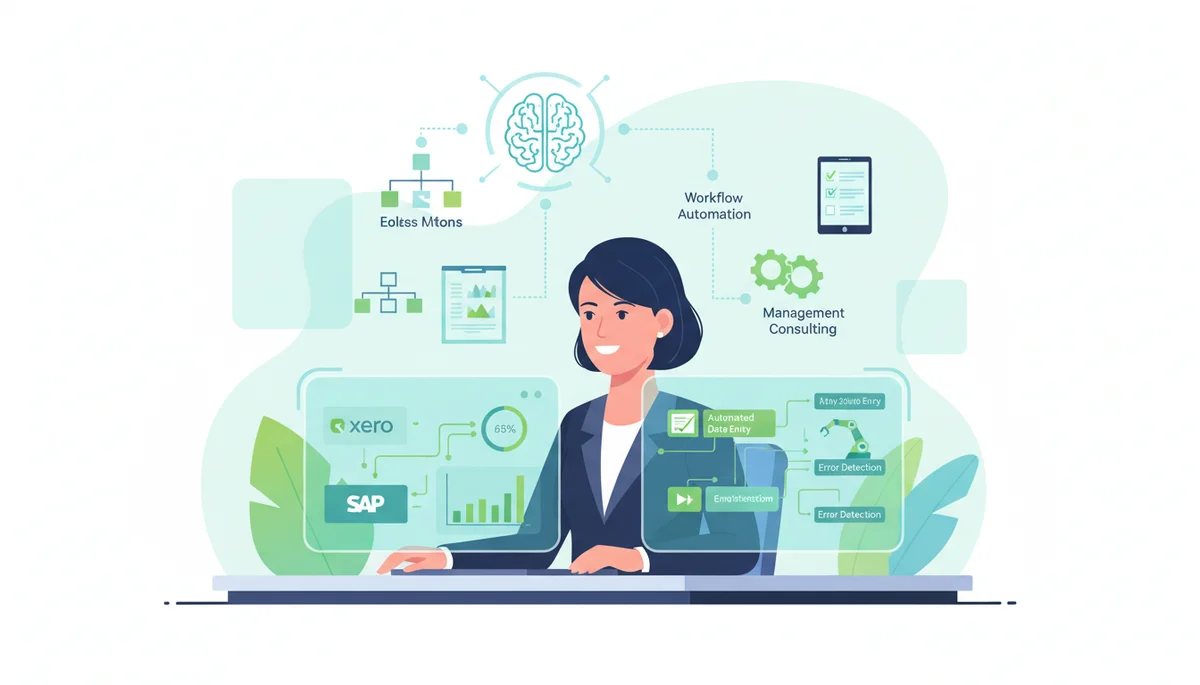
Picture this: you are the founder of a consulting business. Maybe you run a firm like Victor Consulting, managing a team of specialists across multiple client projects. Your days are packed with strategy sessions, client pitches, and team leadership. But somewhere between delivering great work and growing revenue, you have also become the unofficial ERP administrator, bookkeeper, and data entry clerk.
Sound familiar? You are not alone. According to recent research, Australian SMB founders spend an average of 12 to 15 hours per week on administrative tasks, with ERP and financial system management eating up a significant chunk of that time. That is nearly two full working days every week spent on tasks that do not directly grow your business.
The ERP Trap: When Your Business Tools Become Your Boss
ERPs like Xero, MYOB, SAP Business One, and NetSuite are powerful systems. They manage your finances, track projects, handle invoicing, monitor inventory, and keep your operations running. But they were designed for dedicated administrators, not for founders who are also the sales team, the strategist, and the client relationship manager.
For a consulting firm founder, the daily ERP grind typically looks like this:
A Founder's Typical ERP Day
7:00 AM: Reconcile bank feeds
Match transactions, categorise expenses, chase missing receipts from team members.
9:30 AM: Generate and send invoices
Create invoices for completed milestones, adjust for scope changes, follow up on overdue payments.
11:00 AM: Update project tracking
Log billable hours, update project budgets, check resource allocation across engagements.
2:00 PM: Run reports for a client meeting
Pull P&L statements, cashflow projections, and project profitability reports from the ERP.
5:30 PM: BAS preparation and compliance
Review GST categories, check for errors before the quarterly deadline, reconcile superannuation.
Every one of these tasks is important. But none of them require the strategic thinking of a founder. They require accuracy, consistency, and attention to detail. Exactly the strengths of an AI Employee.
What an AI Employee Actually Does With Your ERP
An AI Employee is not a chatbot that answers questions about your ERP. It is a digital team member that actively works inside your systems, performing tasks that would otherwise consume your day. Think of it as hiring a highly capable operations assistant who never sleeps, never makes typos, and never forgets a deadline.
Here is how an AI Employee transforms ERP management for consulting firm founders:
1. Automated Financial Operations
What it handles:
- Bank feed reconciliation across multiple accounts
- Expense categorisation with learned business rules
- Receipt matching and follow-up reminders to team
- GST classification and BAS preparation
- Superannuation reconciliation
Founder benefit:
Instead of spending two hours each morning on bank reconciliation, you get a daily summary: "All 47 transactions categorised. Three items flagged for your review. BAS is 94% ready for Q3." You review the exceptions, approve them in minutes, and move on.
2. Smart Invoicing and Collections
What it handles:
- Generating invoices from project milestones and timesheets
- Adjusting for scope changes and contract variations
- Sending payment reminders on schedule
- Tracking debtor days and flagging at-risk accounts
- Matching payments to invoices automatically
Founder benefit:
Cash flow improves because invoices go out on time, every time. No more "I forgot to invoice that client for last month's work." The AI Employee monitors payment patterns and alerts you when a usually reliable client is late, so you can have a conversation before it becomes a problem.
3. Real-Time Project Profitability
What it handles:
- Tracking billable vs non-billable hours across projects
- Calculating real-time project margins
- Comparing actual vs quoted costs per engagement
- Identifying scope creep before it erodes profit
- Resource utilisation reporting
Founder benefit:
You know exactly which clients and projects are profitable in real time, not three months after the engagement ends. The AI flags projects drifting over budget early, giving you time to renegotiate scope or adjust resourcing before margins evaporate.
4. Intelligent Reporting and Insights
What it handles:
- Generating weekly financial summaries in plain English
- Cashflow forecasting based on pipeline and payment history
- Comparing performance against industry benchmarks
- Board and partner reporting preparation
- Custom dashboards pulled from ERP data
Founder benefit:
Every Monday morning, you receive a concise summary: revenue this month, outstanding invoices, cash position, upcoming payroll obligations, and any red flags. No logging into the ERP, no clicking through six different reports. Just the information you need to make decisions.
5. Compliance and Deadline Management
What it handles:
- BAS preparation and lodgement readiness checks
- PAYG withholding calculations
- Superannuation guarantee compliance monitoring
- ATO deadline tracking and reminders
- Year-end preparation and accountant liaison
Founder benefit:
No more panicking before BAS deadlines. The AI Employee maintains compliance readiness continuously, not just at quarter end. Your accountant gets clean, well-organised data, which means fewer billable hours from them and fewer surprises for you.
Real-World Scenario: A Week With Victor Consulting
Let us walk through how this works in practice. Imagine Victor Consulting, a mid-sized consulting firm with 15 employees, running Xero for accounting and a project management tool for client engagements.
Before AI Employee
After AI Employee
Monday Morning, 7:30 AM
Victor, the founder, opens his phone and sees a message from his AI Employee: "Good morning. Here is your weekly summary. Revenue on track at $127K for March. Three invoices totalling $34,200 are overdue. Two bank transactions need your review. Project Alpha is at 78% budget with 65% of work completed, so I have flagged it for attention. BAS for Q3 is 91% ready with 23 days until the deadline."
Victor reviews the two flagged transactions in about four minutes, approves them, and moves on to his first client meeting. The AI Employee sends polite payment reminders to the three overdue accounts and updates the project tracking board.
Wednesday Afternoon
A team member completes a project milestone. The AI Employee automatically generates the milestone invoice from the contract terms in the ERP, applies the correct GST treatment, and sends it to the client with the appropriate supporting documentation. Victor gets a notification: "Invoice #1087 for $18,500 sent to Meridian Corp for Project Beta, Phase 2 completion."
Friday Evening
The AI Employee reconciles the week's transactions, categorises expenses, and prepares a quick summary for Victor's weekend review. It also notices that a contractor's invoice has been submitted twice with slightly different amounts and flags it: "Possible duplicate invoice from DataWorks: $4,200 on 3 March and $4,250 on 5 March for the same deliverable. Please confirm which is correct."
Without the AI Employee, that duplicate would likely have been paid, costing the business $4,200.
Which ERP Systems Can an AI Employee Work With?
Agentive's AI Employees integrate with the most popular ERP and business systems used by Australian businesses:
| System | Type | AI Employee Capabilities |
|---|---|---|
| Xero | Accounting | Full reconciliation, invoicing, BAS, reporting |
| MYOB | Accounting | Payroll, invoicing, expense tracking, compliance |
| SAP Business One | Full ERP | Financial management, project tracking, procurement |
| NetSuite | Cloud ERP | Multi-entity management, project accounting, analytics |
| QuickBooks | Accounting | Bookkeeping, invoicing, expense management |
| HubSpot | CRM | Pipeline management, client tracking, deal automation |
The AI Employee connects to these systems through their APIs, working inside them just as a human employee would. No manual data export, no spreadsheet wrangling, no switching between tabs.
The ROI: What Founders Actually Get Back
The return on investment for an AI Employee managing ERP tasks is not just about saving money. It is about what you do with the time you reclaim.
What 13 Hours Per Week Buys You
Two more client meetings per week
At an average consulting rate of $250/hour, that is $2,500 in potential new revenue every week.
Faster cash collection
Reducing debtor days from 42 to 28 on a $150K monthly revenue means roughly $70K improvement in working capital.
Fewer errors, fewer costs
Catching duplicate invoices, miscategorised expenses, and GST errors saves thousands per quarter.
Lower accounting fees
Clean, well-organised ERP data means your accountant spends less time sorting and more time advising. Typical savings: 30 to 40% on bookkeeping costs.
Peace of mind
Knowing your compliance is always up to date and your numbers are accurate means fewer sleepless nights before BAS deadlines.
Why Not Just Hire a Bookkeeper or Admin?
You absolutely can. And for many businesses, a part-time bookkeeper makes sense. But consider the comparison:
| Factor | Part-Time Bookkeeper | AI Employee |
|---|---|---|
| Monthly cost | $2,000 to $4,000 | From $399 |
| Availability | Business hours only | 24/7 |
| Error rate | Human (1-3%) | Near zero with oversight |
| Scope | Bookkeeping only | Finance + operations + reporting |
| Sick days and leave | Yes | Never |
| Scales with growth | Need to hire more | Scales automatically |
The ideal setup for most consulting firms? An AI Employee handling the daily grind, with a human bookkeeper or accountant reviewing the output quarterly. This gives you the best of both worlds: speed and consistency from AI, strategic judgement from a human professional.
Getting Started: Three Simple Steps
Book an AI Discovery Call
We analyse your current ERP setup, identify the biggest time drains, and map out which tasks an AI Employee can take over immediately.
Onboarding and Configuration
We connect your AI Employee to your ERP, configure your business rules, and train it on your specific workflows. This typically takes one to two weeks.
Go Live With Human Oversight
Your AI Employee starts working, with our team reviewing outputs during the first month to ensure accuracy. After that, it operates independently with your approval on key decisions.
Stop Being Your Own ERP Admin
You built your consulting firm because you are great at solving problems for clients. Every hour you spend reconciling bank feeds, chasing invoices, or preparing BAS is an hour you are not spending on the work that actually grows your business.
An AI Employee does not replace your strategic thinking. It handles the operational work that keeps your ERP humming, your finances accurate, and your compliance on track. It gives you back the time to do what only you can do: lead your business.
Whether you are running a 5-person boutique consultancy or a 50-person professional services firm, the question is the same: would you rather spend your Monday morning reviewing a two-minute summary from your AI Employee, or logging into your ERP for two hours of data entry?
Ready to Free Yourself From ERP Admin?
Book a free 30-minute AI Discovery call. We will analyse your ERP setup and show you exactly which tasks an Agentive AI Employee can handle for your consulting firm.